Yes, But What Does It Actually Mean? | No. 9
Regression to the mean, the flight instructors who thought shouting worked, and why things improve after you intervene
You wake up with the worst cold you’ve had in years. By the evening you’re desperate enough to try the remedy your neighbour swears by: hot honey, lemon, a spoonful of something from the back of the cupboard. The next morning you feel noticeably better. The remedy works.
Or does it? You took it at the moment you felt worst. And the moment you feel worst is, almost by definition, the moment just before you start feeling better. Colds peak and then fade. You would have improved by the next morning whatever you’d taken, including nothing at all. The remedy got the credit for something that was going to happen anyway.
That’s regression to the mean, and it’s one of the most common ways that doing something gets mistaken for doing something useful.
The flight instructors
The story that made this famous comes from the psychologist Daniel Kahneman, who was teaching a course for flight instructors in the Israeli Air Force.
He was explaining that praise is a better motivator than punishment, and one of the instructors pushed back. In his experience, he said, it was the other way round. When he praised a cadet for an excellent manoeuvre, the next attempt was usually worse. When he shouted at a cadet for a poor one, the next attempt was usually better. So, he concluded, praise makes people worse and shouting makes them better.
His observations were accurate. His conclusion was wrong.
An excellent manoeuvre is, partly, a cadet having a good moment: skill plus a bit of luck. The next attempt is likely to be closer to that cadet’s normal, which means worse, praise or no praise. A terrible manoeuvre is skill plus a bit of bad luck, and the next attempt is likely to be closer to normal too, which means better, shouting or no shouting. The instructor was watching performance drift back towards average after every extreme, and crediting his own reaction for the drift. He had, in effect, trained himself to believe that shouting worked, because the numbers rewarded him for it every time.
How it works
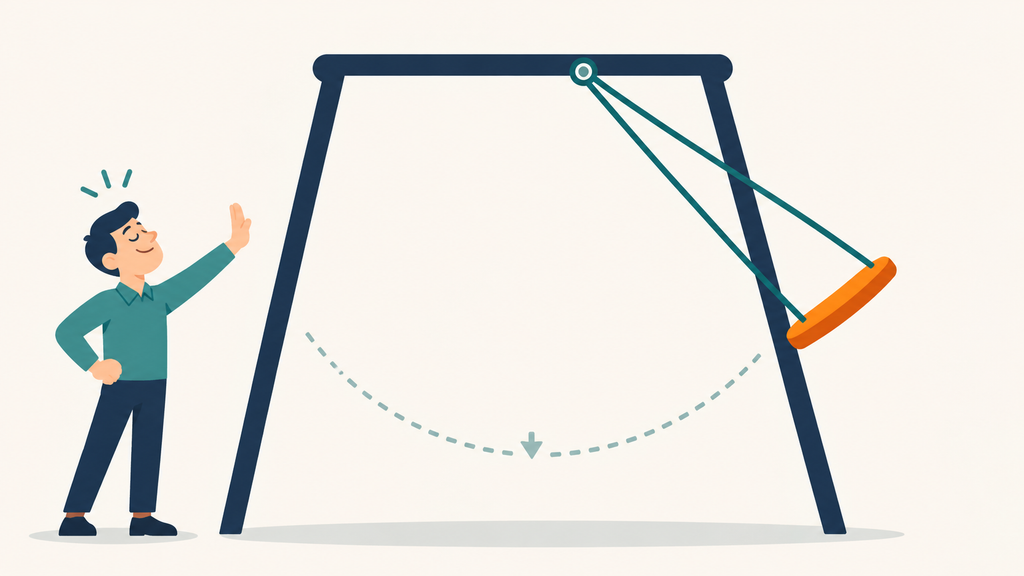
Almost anything you measure is a mix of something stable and something that varies. A student’s mark is their ability plus how the day went. A module’s pass rate is how well it’s taught plus which students happened to take it that year. A road’s accident count is how dangerous it is plus chance.
When you pick something out because it was extreme – the worst result, the highest score, the most accidents – you are partly picking out the luck. Next time, the luck is unlikely to repeat. So the extreme moves back towards the middle on its own. The further out it was, the further it tends to come back.
Nothing has caused that movement. It’s a feature of measuring things that vary, combined with choosing the extremes.
Road safety has wrestled with this for years. Speed cameras are typically installed at sites with an unusually high number of recent accidents. The following year, accidents at those sites usually fall. Some of that fall is the camera. But a site chosen for a bad year would be expected to have a better one next year with no camera at all, and studies of camera effectiveness have had to separate the two to work out what the cameras were achieving.
Why we fall for it
We act when things are at their worst. That’s sensible: nobody launches a rescue plan for something that’s going fine. But it means our interventions are timed to coincide with the moment things were most likely to improve anyway. Act at the bottom, and the bounce that follows will look like your doing.
It’s also a satisfying story. You saw a problem, you acted, the problem got better. Nobody wants to hear that it might have got better without them.
Closer to home
This one is everywhere in education, because so much of what institutions do is aimed at the lowest performers.
Take the students who scored worst in their first assessment and give them extra support. At the next assessment, their marks go up. The support worked. Except that some of those students had a bad day, a bad week, a clash with a deadline elsewhere, and would have scored better next time regardless. The group selected for being at the bottom was always going to drift upwards.
The same goes for the module with the worst pass rate this year, which gets a review and a new action plan, and improves. Or the department flagged for low satisfaction scores, which puts a programme in place and sees scores rise. Some of that improvement may be real. Some of it is what extreme results do next. And if you credit all of it to the intervention, you’ll keep funding things that may not be doing much, and you’ll learn the wrong lessons about what works.
The reverse catches people too. The star performers singled out for praise or a pilot role who then have a less impressive year aren’t necessarily coasting. They’re coming back towards their normal, like the cadets after an excellent landing.
What to ask instead
Was this picked because it was extreme? If the group, site or module was chosen for being the worst or the best, expect some movement back towards average whatever you do.
What would have happened without the intervention? The cleanest way to find out is a comparison group: similar students, modules or sites that were just as extreme but didn’t get the intervention. If they improved as much, the intervention wasn’t the reason.
Is one year enough to judge? An extreme result in a single year is a weak basis for action and an even weaker basis for claiming success. Look at the pattern over several.
And the one that keeps you honest: would I be this confident it worked if things had improved without me?
The point
Regression to the mean doesn’t mean interventions never work. Plenty do. It means that improvement after an intervention isn’t, on its own, evidence that the intervention caused it, especially when you intervened because things were at their worst.
So the next time something bounces back after you stepped in, it’s worth asking how much of the bounce was yours. Because yes, things got better. But what does it actually mean?