Introducing the Sparkline Data Lab
Every year, in providers across the country, someone sits down with a HESA quality report and fixes a rule they fixed last year. They don’t remember how they fixed it last time, because last time it was someone else, or because twelve months is a long time and the notes went wherever notes go. So they work it out again from the coding manual, under deadline, and next year someone will do the same.
I’ve watched that happen for most of my career, and I’ve done it myself more times than I’d like to admit. The Data Lab is my attempt to stop it.
What it is
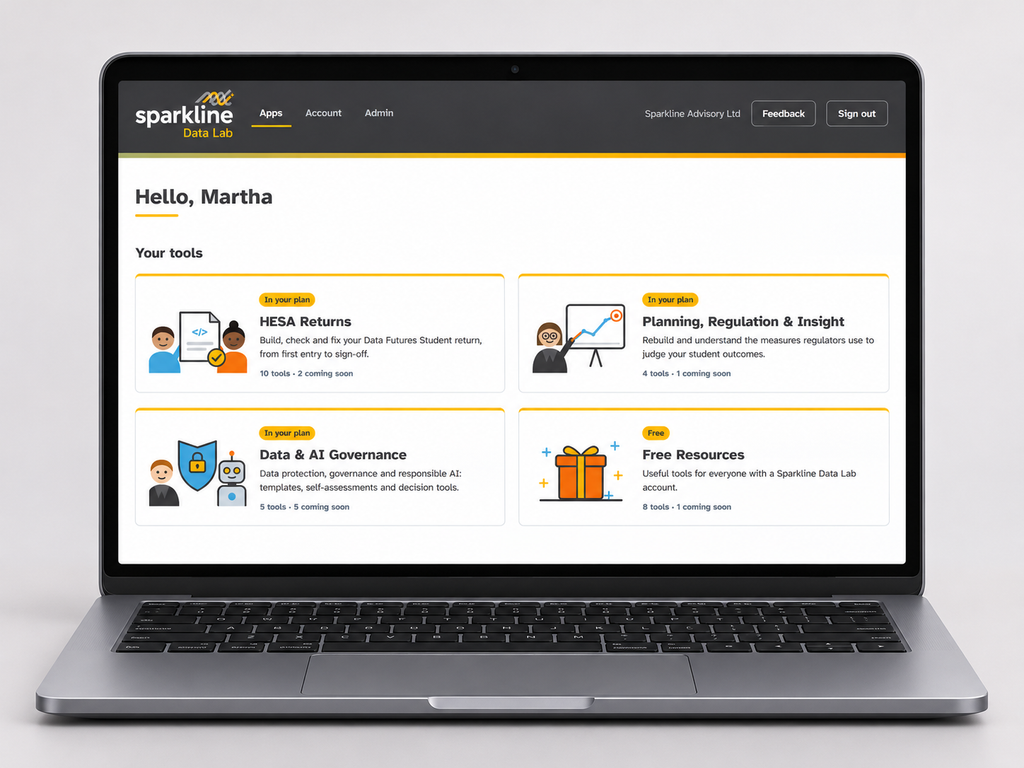
The Sparkline Data Lab is an online portal of practical tools for higher education data teams. Not a course, not a report, not a consultancy engagement: tools you log into and use, built around the jobs that eat your time – HESA returns, regulatory data, data protection and governance.
It has four areas.
Free resources, open to anyone with an account. An OfS registration data readiness check: ten minutes, red, amber and green, on the data side of registration. An enrolment form template covering every HESA field you need from the student, with suggested questions. A statutory returns calendar with every HESA date and countdowns, exportable straight into Outlook or Google. Plus a HESA data model explorer, a B3 outcomes comparison tool, and decision tools for AI use.
HESA Returns. The centrepiece is the Fix List: a shared working list of your quality rule issues. Upload each report and it shows what’s new, what’s worse, what’s cleared and what’s come back, who’s dealing with each issue and how it was fixed. The following year, it shows you how you fixed the same rule last time. That’s the problem from the top of this post, solved: the knowledge stays with the organisation when the person moves on. Alongside it are tools for fixing records student by student rather than rule by rule, and for checking courses and subjects before the credibility report does it for you.
Planning, Regulation and Insight, for making sense of regulatory measures and student outcomes.
Data and AI Governance. Short courses with completion certificates, including OfS metrics decoded and a primer on the Data (Use and Access) Act. Data breach exercises your team can run together without needing an expert in the room. A guided DPIA template for common HE scenarios.
Your student data stays with you
This was non-negotiable for me, and it should be for anyone you let near your student records. The tools that work with student data run in your browser. Your files are opened and processed on your own computer and are never uploaded to us. The portal stores what it needs to run – your account, course results, and for the Fix List, rule-level counts and notes, never student records. If your DPO wants the detail, I’ll send them a one-page summary. There’s nothing to install either, which your IT team will appreciate.
Who it’s for, and how it’s priced
It’s built for HE data teams of every size, but I had smaller providers in mind throughout, because they carry the same returns and the same regulatory scrutiny as large universities with a fraction of the people. Pricing reflects that. The free resources are free. The paid areas are annual subscriptions per organisation, priced by student numbers, so a provider with 80 students isn’t paying what a university with 20,000 does. You can subscribe to one area on its own; most HESA teams start with HESA Returns. And access covers your organisation, so everyone you add sees the same tools.
What it isn’t: a replacement for HESA’s own guidance or the OfS. The coding manual is still the authority. The tools get you there faster and with fewer mistakes, and they support your judgement rather than replacing it. If you need advice on your own situation, that’s what the consultancy side of Sparkline is for.
Getting in
The doors are opening now. You can sign up for the free resources today, with full subscriptions coming soon. Organisations that join early can ask about Founding Member pricing, available for a limited time – mention it when you request access, or email portal@sparklinedatalab.com.
If you’re heading into your next return wondering whether this year will be any different, have a look around first. https://sparklineadvisory.com/data_lab/data-lab-portal/