

AI-assisted applicant enquiry handling
A worked application of the ICE/BERG framework
Purpose of this paper
Frameworks are easy to agree with and hard to apply. Most responsible AI guidance is accepted in principle and then set aside when someone needs to get something done by Thursday.
This paper takes the ICE/BERG framework and applies it in full to one realistic use case: an applicant-facing enquiry chatbot at a higher education provider. The use case has been chosen deliberately. It is common, it looks low risk, and it fails in a way that is difficult to detect and expensive to recover from.
The paper sets out where the framework came from, why it is structured the way it is, how it relates to the established AI literacy frameworks, and where it is weakest. It is written for people making decisions about AI in professional services functions, and for anyone assessing whether the framework is useful to them.
Where the framework came from
ICE/BERG came out of questions, not theory.
It was developed while delivering AI sessions to professional services staff in UK higher education and attending a good many delivered by others. The content was almost always about tools and models: which one to use, how to write a better prompt, what the latest release could do. The questions afterwards were rarely about any of that. They were about whether people were allowed to use it. Whether a student’s name could go into a prompt. What happened if the output was wrong and had already been sent. Whether anyone needed to be told AI had been involved.
Those questions were going unanswered, because the sessions had not been designed to answer them. The training was pitched at capability, and the anxiety was about permission.
This is a familiar pattern from data governance. It is the same problem as data literacy training that teaches people to build a chart without telling them what they are allowed to do with the data underneath it. ICE/BERG puts the two together.
The framework in brief
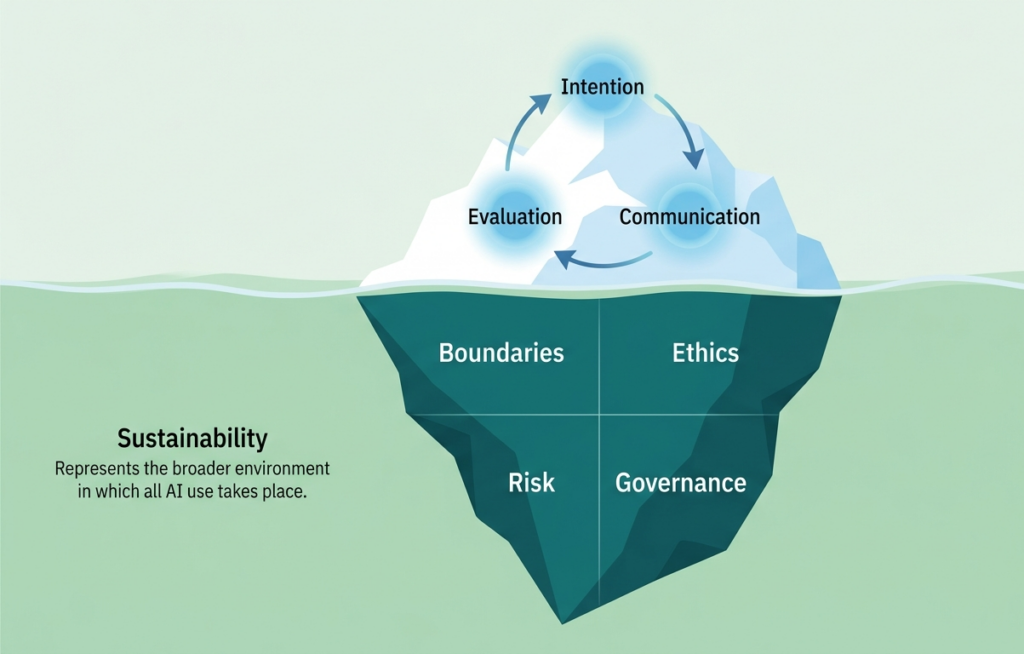
ICE is the repeatable cycle at the heart of every AI interaction. It is what you do, every time.
| I | Intention Know what you want before you start. What does a good outcome look like? Being clear about your purpose shapes everything that follows and stops you reaching for AI out of habit rather than need. |
| C | Communication Direct the AI clearly and deliberately. The quality of what you put in shapes the quality of what you get out. This is a skill that develops with practice. |
| E | Evaluation Do not just accept the output. Check it, question it, and apply your professional judgement before you use it. You are responsible for what you produce, whether AI was involved or not. |
BERG is the mass beneath the waterline. These four considerations sit under every interaction and shape how well it goes.
| B | Boundaries Know what you can and cannot use AI for in your role and institution. Understand what information should never go into a prompt, and work within your organisation’s policies. |
| E | Ethics Consider fairness, transparency and bias. Think about the people affected by AI-assisted work and decisions, and whether the way you are using AI is something you could explain and stand behind. |
| R | Risk Understand the limitations of the tools. Know how much you can rely on outputs for a given purpose, and factor in what could go wrong before you choose your approach. |
| G | Governance Be accountable for what you produce. Know what disclosure is needed, who owns the output, and how quality is assured before anything goes further. |
Sustainability is the sea the iceberg sits in. It is not a step, and it is not a foundation, but the condition everything else takes place within.
| S | Sustainability Consider the environmental cost of AI use, the carbon footprint of the tools you rely on, and whether your practice builds genuine capability over time. Sustainable AI use means developing your own skills and judgement rather than creating dependency. |
Why the framework is shaped this way
The iceberg is not decoration. It carries the argument.
The visible part is small. Intention, communication and evaluation are the three things you do at the point of use; they are the things you can practise, and they are what almost all AI training covers. The mass below the waterline is larger, it does not change from one interaction to the next, and it determines whether the interaction above it goes well.
The split does a second job. Above the waterline is individual behaviour, and it can be improved by the individual this week. Below the waterline is largely institutional condition. A member of staff can be aware of boundaries but cannot set them for the organisation from their desk. Separating the two stops the framework blaming individuals for institutional failure, which is a common weakness in responsible AI guidance.
ICE is a cycle because evaluation feeds intention. What is learned from a poor output will change what is asked for next time. BERG is static because foundations are not a process to be worked through, they are conditions that are either in place or not.
Sustainability sits as the sea rather than an eighth letter because it operates at two scales at once: the environmental cost of the tools, and whether the practice is building capability or quietly replacing it. It is a condition, not a step.
How ICE/BERG relates to other AI literacy frameworks
There is no shortage of AI literacy frameworks. UNESCO published competency frameworks for teachers and for students in September 2024 (Miao and Cukurova, 2024; Miao and Shiohira, 2024). EDUCAUSE published a framework for AI literacy in teaching and learning in October 2024 (Kassorla, Georgieva and Papini, 2024). The Digital Education Council has published a human-centred model. The underlying academic definition most of these work from is Long and Magerko (2020), later developed for higher education contexts by Laupichler and colleagues (2022).
Most of these are competency taxonomies. They describe what a person should know and be able to do, usually across proficiency levels, and they are designed to support curriculum design and institutional strategy. They do that job well.
ICE/BERG has a different unit of analysis. It does not describe a competent person; it describes a single interaction and what has to be true around it. That makes it less useful for designing a programme of study and more useful at the point of use. It is also aimed at staff in professional services roles rather than at academics or students, which is where the sector’s AI literacy attention has largely been directed.
| The distinction in one line A competency framework asks whether the person is ready. ICE/BERG asks whether this particular use is sound. |
The use case: an applicant enquiry chatbot
A provider adds a chatbot to its website to handle applicant enquiries. It is grounded on institutional content: entry requirements, fees, deadlines, English language requirements, application dates. It is procured to reduce pressure on a small enquiries team during peak cycle.
It works well at launch. Six months later a policy changes and the source content behind the chatbot does not.
The chatbot carries on answering. Confidently, consistently, and wrongly, to everyone who asks, until somebody notices.
This case is useful because of what it does to the framework’s shape. The ICE cycle happens once, at configuration. Every interaction after that runs with no human in it. The visible part of the iceberg is almost absent, and the entire arrangement is resting on the foundations.
Above the waterline
| I | Intention What is it actually for? Reducing enquiry volume and giving applicants accurate answers are different objectives that point to different configurations. If the business case was staff workload, accuracy was an assumption rather than a requirement, and nobody wrote down what an acceptable error rate would be. |
| C | Communication What has the system been told to do when it does not know? Most conversational tools are configured to always produce an answer. That is a decision about tone which becomes a decision about risk. A handover to a human is a communication choice with a governance consequence. |
| E | Evaluation Who is reading transcripts, and how often? Evaluation at launch is not evaluation. Where an interaction repeats at scale with no human in the loop, evaluation has to be a scheduled activity with an owner, or it does not happen at all. |
Beneath the waterline
| B | Boundaries What content may it draw on, and what are applicants typing into it? People disclose disability, immigration circumstances and financial hardship to a chatbot far more readily than to a person. That data has to be lawfully processed, retained under a defined schedule, and covered by the provider’s privacy information. The ICO expects a data protection impact assessment to evidence that less risky alternatives were considered (ICO, 2023). |
| E | Ethics The applicants most likely to depend on the chatbot are those without family or school knowledge of UK higher education, and those applying from outside the UK in a second language. Wrong information falls hardest on people with the least other recourse. A tool introduced to improve access can quietly widen the gap it was meant to close. |
| R | Risk A member of staff gives out a wrong fee figure once. A chatbot gives it out every time it is asked, silently, at volume. Applicants are also prone to accepting an automated answer without challenge, an effect documented across four decades of automation research (Parasuraman and Riley, 1997; Skitka, Mosier and Burdick, 1999; Parasuraman and Manzey, 2010). Confident presentation makes verification feel unnecessary. |
| G | Governance Who owns the underlying content, and is there anything that connects a policy change to a review of what the chatbot says? Could the provider reconstruct what a given applicant was told on a given date? Information given to applicants about courses, fees and entry requirements is material information for consumer protection purposes (CMA, 2023), and the medium that delivered it does not change that. |
The sea
| S | Sustainability The resource being spent here is trust. An applicant who discovers they were given the wrong deadline does not conclude that the content behind a chatbot was out of date; they conclude the provider is disorganised, and they tell people. Meanwhile the enquiries team that used to hold this knowledge has spent six months not using it, and the institutional memory of why the policy changed sits with nobody. |
What the case shows
Three things are worth drawing out.
- The tip of the iceberg was almost absent. One configuration decision governed several thousand interactions. Where AI is embedded in a process rather than used at a keyboard, the ICE cycle collapses to a single moment and the foundations carry everything.
- The person affected never chose to use AI. Most AI literacy material assumes the user and the affected party are the same person. In admissions they rarely are. The applicant did not select the tool, cannot assess its reliability, and in many cases does not know it is a tool.
- Nothing here required the technology to malfunction. The chatbot performed exactly as designed throughout. The failure was governance: no link between a policy change and a content review. This is the ordinary way AI goes wrong in an institution, and it is not the failure mode most AI training prepares people for.
Limitations of the framework
A framework that cannot be criticised is not being used. Four limitations are worth stating plainly.
It is normative and it is not validated
ICE/BERG describes what good practice looks like, drawn from two decades in the sector and many questions asked in many rooms. It has not been tested against outcomes. What honest validation would look like is not obvious: self-reported confidence is easy to measure and close to meaningless, and the failures the framework exists to prevent are precisely the ones that go unreported.
Boundaries come first
Putting boundaries at the head of BERG arguably teaches caution before capability. There is a reasonable case that this produces staff who are compliant and unadventurous at a point when the sector needs people willing to try things. The counterargument is that the questions people actually asked were about permission, and a framework that ignores that answers a question nobody had.
Sustainability as the sea makes it structurally central and easy to ignore
Representing sustainability as the environment rather than as a step makes a genuine claim about its scope. It also makes it scenery. A sea is easy not to look at, and in practice it is the element most likely to be nodded at and skipped.
It assumes the user can shape the interaction
Increasingly they cannot. When a provider procures a specialist admissions, enrolment or enquiry platform, intention and communication have been settled by the vendor before anyone in the institution touches the system, and evaluation is constrained to what the interface chooses to surface. Applied to procured systems, ICE/BERG has to be used at the point of procurement, by people who may not think of themselves as AI users at all. That is a different conversation with a different audience, and the framework does not yet say enough about it.
Open questions
- Whether the framework holds at institutional level as well as individual, or whether an institutional variant is needed.
- Whether governance and boundaries are sufficiently distinct to warrant separate elements, given how much they overlap in practice.
- How the framework should be applied to procured and embedded AI, where the ICE cycle sits with a vendor.
- What validation would look like that measures something other than confidence.
- How the framework interacts with the statutory ICO code of practice on AI and automated decision-making now in development, and with the reformed automated decision-making provisions under the Data (Use and Access) Act 2025.
References
Competition and Markets Authority (2023) UK higher education providers: advice on consumer protection law. Updated May 2023.
Information Commissioner’s Office (2023) Guidance on AI and data protection. Updated March 2023.
Kassorla, M., Georgieva, M. and Papini, A. (2024) AI literacy in teaching and learning: a durable framework for higher education. EDUCAUSE, 17 October 2024.
Laupichler, M.C., Aster, A., Schirch, J. and Raupach, T. (2022) Artificial intelligence literacy in higher and adult education: a scoping literature review. Computers and Education: Artificial Intelligence, 3.
Long, D. and Magerko, B. (2020) What is AI literacy? Competencies and design considerations. Proceedings of the 2020 CHI Conference on Human Factors in Computing Systems.
Miao, F. and Cukurova, M. (2024) AI competency framework for teachers. Paris: UNESCO.
Miao, F. and Shiohira, K. (2024) AI competency framework for students. Paris: UNESCO.
Parasuraman, R. and Manzey, D.H. (2010) Complacency and bias in human use of automation: an attentional integration. Human Factors, 52(3), pp. 381-410.
Parasuraman, R. and Riley, V. (1997) Humans and automation: use, misuse, disuse, abuse. Human Factors, 39(2), pp. 230-253.
Skitka, L.J., Mosier, K.L. and Burdick, M. (1999) Does automation bias decision-making? International Journal of Human-Computer Studies, 51(5), pp. 991-1006.
About
ICE/BERG is developed by Sparkline Data Lab, the research and frameworks division of Sparkline Advisory Ltd, a data and AI consultancy working with UK higher and further education providers.
Sparkline Data Lab develops the frameworks that underpin the firm’s consulting and training work: Bedrock assesses whether data foundations are ready, ICE/BERG assesses whether an AI use is appropriate, and CLEAR audits AI already in use.