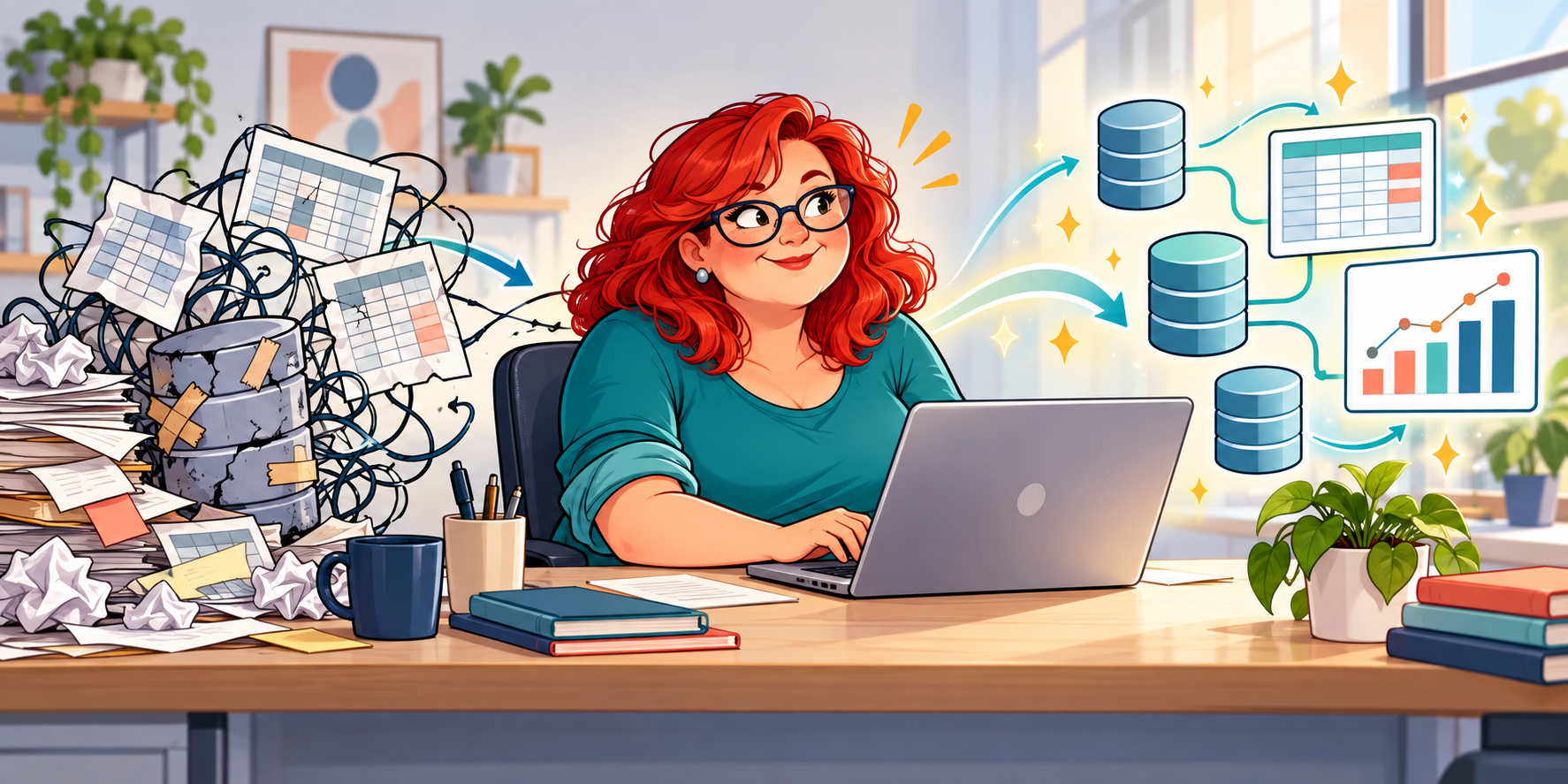
The accidental data person
Nobody sits their eleven-year-old down and asks whether they’ve considered a future in data governance. It isn’t a childhood dream. For most people it isn’t even a decision. It’s something that happens to you while you’re busy doing a different job, and then one day you look up and realise it’s who you are.
I know, because it happened to me.
In 2004 I was an administrator in a departmental office. The job was many things, including applications – processing them, tracking them, the ordinary machinery of getting students from “applied” to “enrolled”. And sitting in the middle of all of it was an Access database that everyone used and nobody liked. It was clunky, it was buggy, and it did roughly three-quarters of what anyone needed it to.
I found it fascinating.
Not the admin. The database. I started tinkering, carefully at first and then less carefully, to work out how the thing was put together and why it kept falling over. This was 2004, so there was no AI to ask and no neat answer to copy from somewhere. There was me, a database I wasn’t really supposed to be rebuilding, and some rudimentary Google searches that I’m amazed turned up anything at all. And it worked. I overhauled the whole thing – fixed the bugs, redesigned how it hung together, made the interface something a human being could use without swearing.
That was the start of my career. No one could stop me after that.
What followed was years of it. Wherever I worked, I found the thing held together with tape and good intentions, and I rebuilt it. Databases. Spreadsheets that had grown into something nobody fully understood. Processes still being done on paper in a way that made no sense in a building full of computers. My job title never mentioned data. I was an administrator, then a Programmes Officer, and the data work was the thing I kept drifting towards in the gaps between my actual duties, because I couldn’t help it.
It took me an embarrassingly long time to notice the obvious. Somewhere in that Programmes Officer role it finally landed: I wasn’t an administrator who was good with data. I was a data person who happened to be doing admin.
(Here’s the small secret underneath all of this, which I’ll let you in on: we’re all data people. Almost everyone is, somewhere, about something. Most just haven’t had their database moment yet.)
Once I’d seen it, I couldn’t unsee it. So I did the thing that felt slightly reckless at the time and turned out to be the best decision I’ve made: I leaned in. I started taking roles that were explicitly about data, rather than roles where data was the bit I did when no one was looking. I got deliberate about it. And some way down that road, the Data Goddess turned up – a name for the thing I’d accidentally become, and a slightly cheeky one, which suited me.
I’m still on the journey. I don’t think it’s the kind that ends. But I have no regrets about how it started, and I couldn’t be happier about where it’s got me.
I tell you this for two reasons, and neither is nostalgia.
The first is for whoever is reading this as the accidental data person in their own institution – the one who became the Power BI expert, the spreadsheet wizard, the person who “just gets it”, without ever choosing to. That pull you feel towards the broken database, the itch to fix the process nobody else wants to think about, is not a distraction from your real job. It might be pointing at your real job. Mine was, and I nearly walked past it.
The second is for anyone who manages one of us. The accidental data person is usually one of the most valuable people in the building and one of the least recognised, precisely because the skill arrived sideways and never came with a title. They’re holding together things that would cost a fortune to replace. It’s worth knowing who yours is, and worth making sure they know that you know.
None of my career looked like a plan. It looked like someone who couldn’t walk past a badly built database without wanting to fix it, following that instinct until it turned into a profession. If you recognise yourself in that, my advice is simple: stop treating it as a side quest. It might be the main one.